Why the Water?
A park can be full of plants-as-food and still be legally inedible. In New York City, picking leaves, fruit, or stalks in a public park is treated as damage to public property. NYC Parks rules prohibit visitors from removing plants or other vegetation from the ground, or from taking vegetation “under the jurisdiction” of NYC Parks without permission.[i] That prohibition is based on a set of assumptions: that if edible plants are available, people will take too much; that plantings and habitat will be harmed; and that if someone eats the wrong plant or the wrong part of a plant and becomes ill, the city could be exposed to liability.
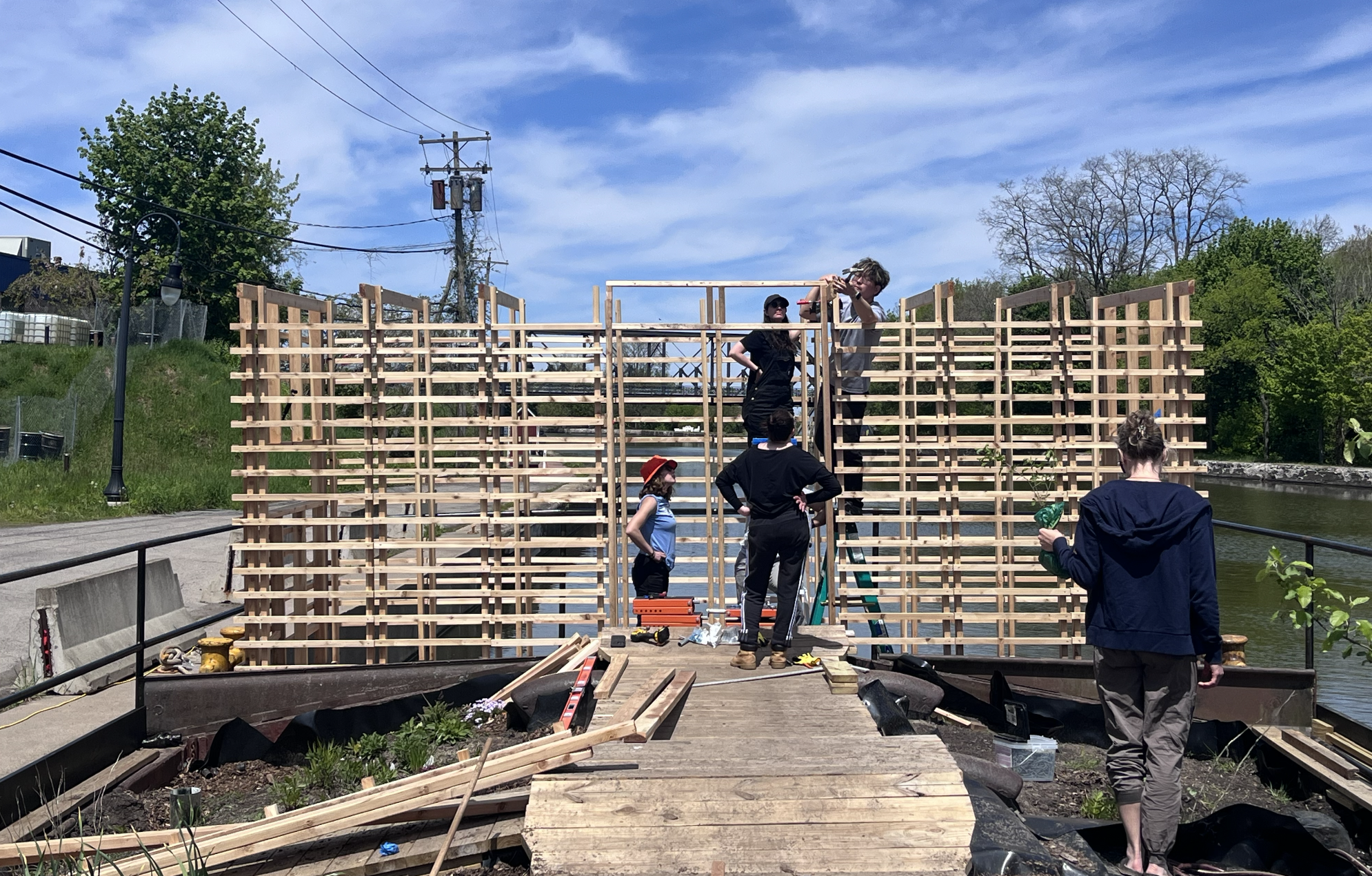
Swale began as a provocation aimed at a prohibition shaped not only by Parks rules, but by longer histories of colonization, Indigenous dispossession, and racialized land access,[ii] and continued through redlining practices that further disadvantaged Black, Brown and poor people from access to arable and forgeable lands.[iii] The provocation proposed by Swale was simply: what would change if access to fresh food from public space were treated as a public benefit instead of a public risk? In 2016, I co-built Swale, a floating food forest on a barge. It was permitted as public art and designed to dock beside parks along New York City’s waterways. Swale’s premise was procedural as much as it was aesthetic and experiential. If foraging is prohibited on public land, then we needed a public platform that was not legally considered “land” but could act as land. Swale relied on the fact that navigable waterways are governed differently than parkland. I have often described that difference as “marine common law,” though more precisely I mean the distinct legal treatment of navigable waters, public access, and the public trust.[iv] In practice, the barge became a legal edge: a commons on water, adjacent to the shoreline, where visitors could taste herbs and fruit while encountering a live dispute about what “public” means, who public space is for, and what kinds of use are permitted.
That edge space was important because climate change does not affect everyone evenly, and because it also carries with it other ecological concerns, namely rising waters, storm surges, and the often-neglected waterfront. Environmental harms and protections are distributed through policy and enforcement: where industry is allowed to operate, where trees are planted, how flood infrastructure is funded, what is inspected and maintained, and whose health risks are treated as acceptable. Food access, asthma, heat, flooding, contamination, and displacement are common in dense urban areas. Laws such as traffic laws or laws determining uses of public space often aid in exacerbating those patterns, by making them acceptable, permissible, and essentially normal operating procedures.
Swale was built as a prototype for a different relationship to public space: one grounded in shared stewardship, mutual responsibility, and the commons as a lived practice rather than an abstract ideal.
The central question was not whether the prohibition should be broken outright, but whether it could be lawfully resolved, and whether resolving it could produce a vision of public space that was both more just and more generative. That distinction between breaking a rule and finding the lawful edge of it is one of the things art is uniquely positioned to explore.
The Prohibition: Public Land as a No-Take Zone
Growing or picking food on New York City’s public land has long been off-limits. By signage and enforcement, visitors and residents know that public space is for relaxing, walking, sitting, recreating, and consuming what you brought with you. It is not a place for foraging from the abundance of fresh and healing plants that are growing there. I believe that this has social consequences. A no-take public landscape tends to produce a particular kind of public. It privileges leisure while neglecting the need for subsistence. Hunger and access to fresh food then become a private problem rather than a public condition: at once systemic and yet possible to help alleviate.
In a city where millions of New Yorkers live in communities with limited access to fresh produce,[v] the prohibition lands hardest where food is already scarce, where public space is already over-policed, and where the costs of living already push people toward inexpensive, packaged foods with little nutritional value.[vi]
The food access problem is bound to patterns of environmental harm that follow the same geographic and economic lines. Communities with limited access to fresh food are often the same communities that bear disproportionate exposure to air pollution, flooding, heat, and industrial contamination. Therefore, the prohibition on foraging in public parks, in this context, is not just a rule about plant removal. It codifies a particular vision of who parks are for and what kinds of uses they are designed to serve. Swale proposed a different premise: that a park can provide more than aesthetics and recreation, that allowing a community to tend and harvest an edible landscape is a form of public health infrastructure, and that the distinction between what is prohibited and what is possible is itself a policy choice.
Swale does not argue that every plant in every park should be foraged, but that a blanket prohibition forecloses the act of stewardship in community parks. A public that cannot touch the living landscape is less likely to care for it, defend it, or imagine it as shared responsibility. In a city with roughly 100 acres of community garden space (where only a small number of people can obtain a plot), the city cares for 30,000 acres of parkland.[vii] Because fresh food is expensive and not everyone has access to it at a grocery store, opening up some of those 30,000 acres for foraging would provide a substantial increase in access to food-producing public space.
[i] New York City Rules, title 56 (New York City Department of Parks and Recreation), §1-04(b)(1) (prohibiting removal of vegetation from Parks property without permission).
[ii] Roxanne Dunbar-Ortiz, An Indigenous Peoples’ History of the United States (Boston: Beacon Press, 2014); Robert Steven Grumet, The Munsee Indians: A History (Norman: University of Oklahoma Press, 2009). For a broader account of Indigenous land dispossession in the northeastern United States, see also Vine Deloria Jr. and Clifford M. Lytle, American Indians, American Justice (Austin: University of Texas Press, 1983).
[iii] Richard Rothstein, The Color of Law: A Forgotten History of How Our Government Segregated America (New York: Liveright, 2017); Alison Hope Alkon and Julian Agyeman, eds., Cultivating Food Justice: Race, Class, and Sustainability (Cambridge, MA: MIT Press, 2011).
[iv] Illinois Central Railroad Co. v. Illinois, 146 U.S. 387 (1892). For an overview of the public trust doctrine, see Joseph L. Sax, “The Public Trust Doctrine in Natural Resource Law: Effective Judicial Intervention,” Michigan Law Review 68, no. 3 (1970): 471–566. National Audubon Society v. Superior Court, 33 Cal. 3d 419 (1983) (the Mono Lake case).
[v] USDA Economic Research Service, “Food Access Research Atlas,” https://www.ers.usda.gov/data-products/food-access-research-atlas/ (accessed 2024); New York City Department of Health and Mental Hygiene, “Community Health Profiles” (2018), https://www.nyc.gov/site/doh/data/data-publications/profiles.page.
[vi] Michele Ver Ploeg et al., Access to Affordable and Nutritious Food: Measuring and Understanding Food Deserts and Their Consequences: Report to Congress, AP-036 (Washington, DC: U.S. Department of Agriculture, Economic Research Service, 2009); New York City Department of Health and Mental Hygiene, “Eating Well in New York City” (2010).
[vii] NYC Parks manages more than 30,000 acres of parkland; see NYC Parks, “About NYC Parks,” https://www.nycgovparks.org/about/faq (accessed 2024). For community garden acreage, see NYC Parks, “GreenThumb Community Gardens,” https://www.nycgovparks.org/programs/gardens/greenthumb (accessed 2024).